With programs like ChatGPT becoming increasingly used by students, professors in the English Department and the School of Communication and Multimedia Studies are left to decide how to address Artificial Intelligence.
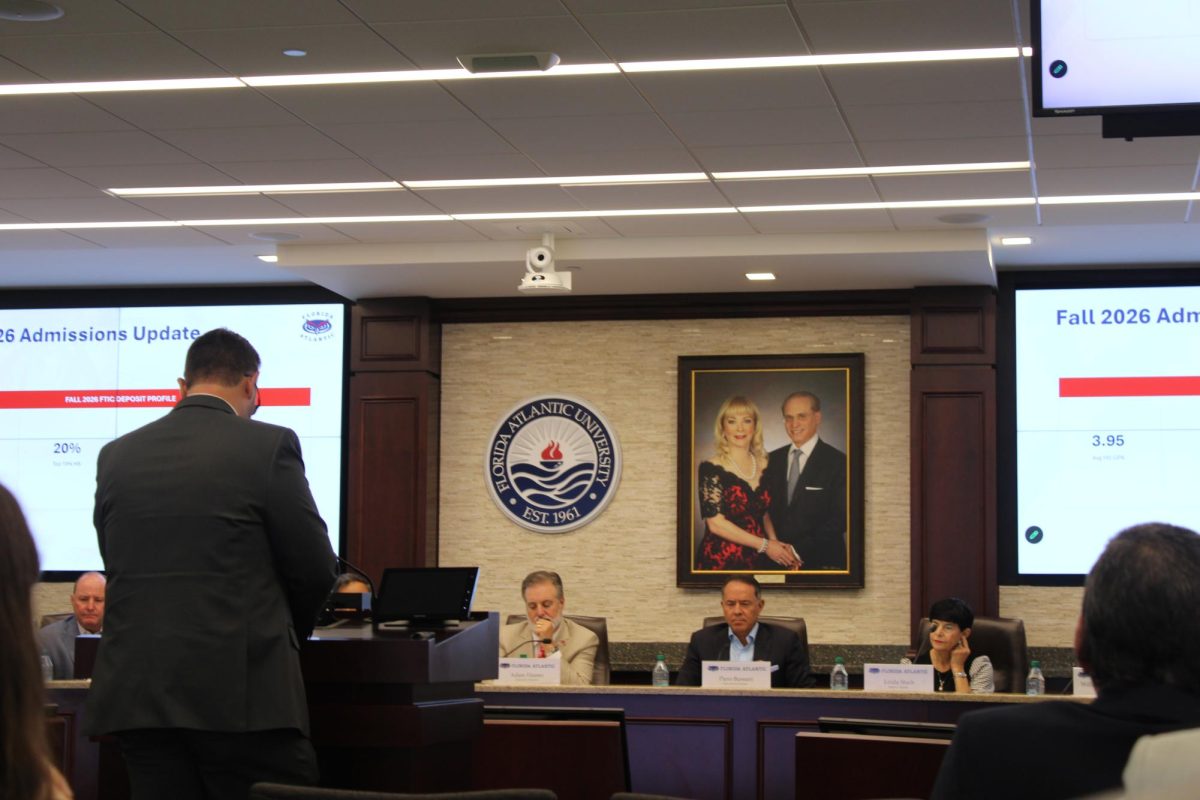
In 2024, the University Faculty Senate (UFS) decided that Florida Atlantic University teachers could set the limitations they wanted to place on AI in their classrooms.
“Class policies related to AI use are decided by the individual faculty. Some faculty may permit the use of AI in some assignments, but not others, and some faculty may prohibit the use of AI in their course entirely,” as outlined in a draft syllabus presented to the UFS on April 29, 2024.
In 2025, Copyleaks, a plagiarism detection platform, released an AI in Education Trends Report. The report surveyed over 1,000 students and found that 90% use AI academically, while 73% have increased their use of AI from 2024 to 2025.
“Institutions should plan for AI as a constant presence in academic life. Traditional assignment formats and teaching approaches may need to evolve to accommodate these shifts, focusing less on banning and more on guiding constructive, transparent usage,” Copyleaks wrote in its report.
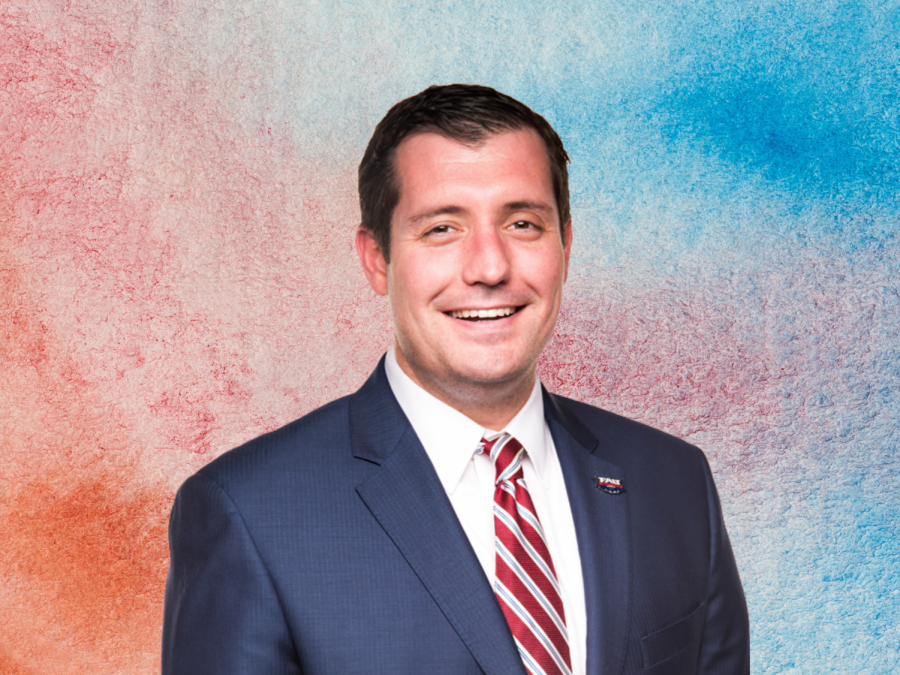
Alexander Slotkin, an assistant professor of rhetoric and composition in the Department of English at FAU, believes generative AI will never replace writers; rather, people need to learn when and when not to use it.
“There are, of course, professors who take the stance that no generative AI will be used in their courses,” said Slotkin. “Instead, I try – when it’s appropriate for the subject – to have students practice using ChatGPT in ways that help them think more critically and reflectively about what they’re producing for others.”
Slotkin says that after discussing with his students the practical affordances, disadvantages, and ethical and environmental concerns of using AI, such as straining water supplies, he will allow them to use it in their writing. “From my experience, the more students learn about generative AI, the less likely they are to use it,” said Slotkin.
Slotkin believes that the increase in AI use says absolutely nothing about society’s creativity. He describes the common idea that every decade has its own literary crisis, which he says boils down to people with some sort of power policing how others speak and write.
“People tend to have the misconception that there is a right way to write, a right way to speak,” said Slotkin. “But there just isn’t. Writing with generative AI isn’t wrong, and it doesn’t diminish your writing capabilities. But using it to do the writing for you does.”
Dimitris Pados, director of the FAU Center for Connected Autonomy & Artificial Intelligence, says that nowadays there are two types of AI.
He describes the more “known” side of AI as Large Language Models (LLMs), such as ChatGPT and Claude, which handle text, audio, and video. The other type Pados describes is Inference AI, more commonly known as Physical AI. “[Physical AI] gets numbers from a sensing modality and executes whatever needs to be executed based on whatever is being sensed directly.”
Pados says that the type of AI “disrupting education” right now is LLMs, because they give students the opportunity to query AI programs and receive answers to complex homework and exam problems very quickly. Pados believes that if teachers wish to combat this, they should implement in-class assignments and exams.
Robert Gutsche, a professor of digital culture in the School of Communication and Multimedia Studies, says that our creativity and confidence are under attack.
“We are in AI systems that give us a lot of affirmation but not a lot of critical reflection or reflexivity about the choices that we’re making and what we’re producing,” said Gutsche.
Gutsche incorporates a variety of physical activities in his classes, including oral exams, presentations, theatrics, dioramas, comic books, and zines. He also describes an activity in which he gives students straws and tasks them to make anything that can be used.
However, Gutsche also sees how an individual’s confidence issues can be reflected in AI usage.
“One of my thoughts is when are we going to get to the point where we don’t worry so much about if AI is writing things for us rather than if it is accurately representing our ideas?” said Gutsche. “But for those who may not feel confident in expressing themselves that way, are the ideas that are coming through helpful?”
Isaiah Sewell is a Staff Writer for the University Press. For information regarding this or other stories, email [email protected] or contact him on Instagram @izayahx_.