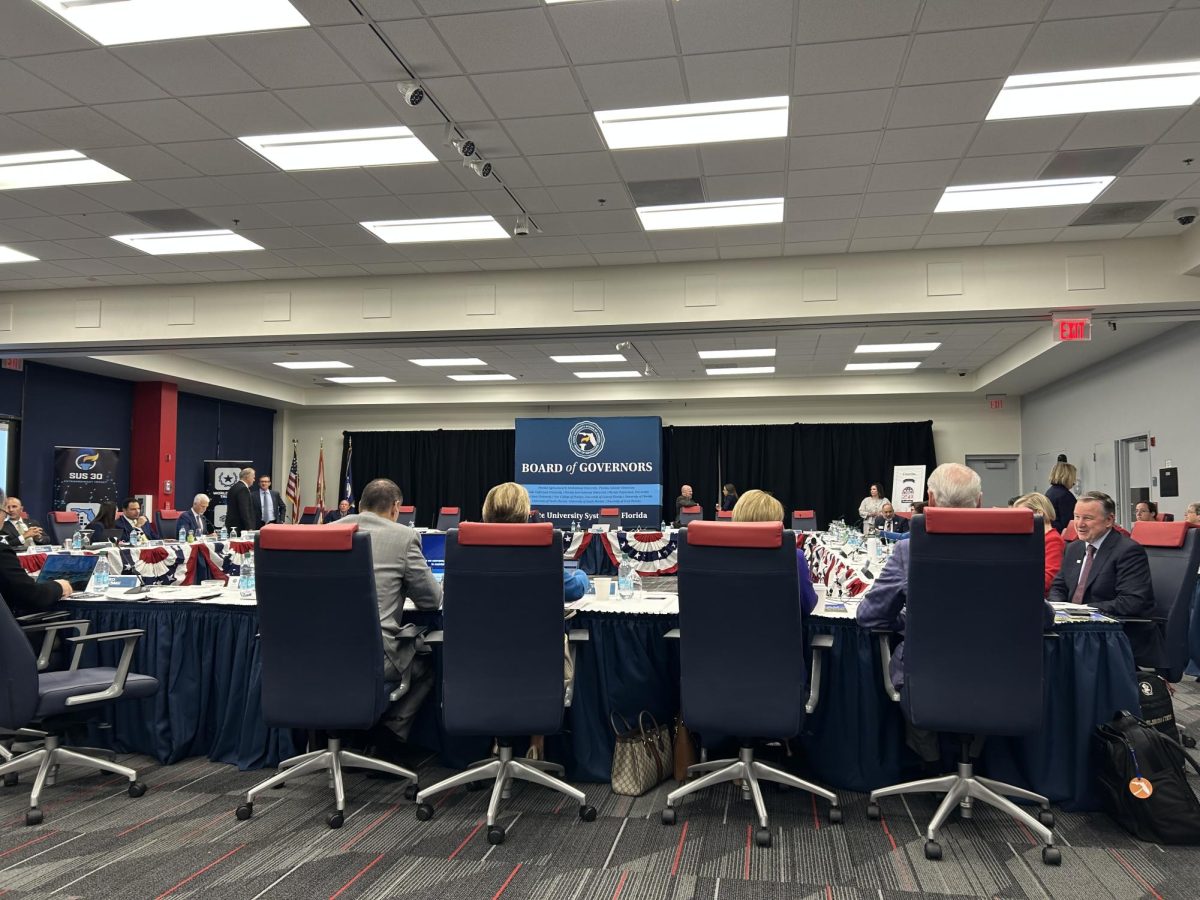
In a routine meeting held on Jan. 29, the Florida Board of Governors (BOG) discussed a potential pause on future H-1B hiring across all Florida public universities. If approved, this motion – introduced with a notice of intent from the State University System of Florida (SUSF) and Chancellor Raymond Rodrigues – could have direct consequences for how public universities across the state recruit faculty and fundamentally operate.
The visa is intended for non-immigrants, or individuals who reside in the U.S. for a limited period. In Florida, holders of H-1B visas are primarily employed in public university positions and are relied on to conduct critical work.
The majority of beneficiaries undertake positions in specialty occupations per U.S. Citizenship and Immigration Services (USCIS) guidelines. This could apply to faculty roles, such as assistant professors or full-time professors. H-1B recipients are also often recognized in academic medicine as advanced practice providers and medical researchers. Their work can be attributed to STEM functions in all of its innovative fields as well.
According to the USCIS, H-1B holders account for approximately 1.7% of the 60,000 total faculty and staff at Florida public universities. Florida Atlantic University currently employs 21 H-1B holders.
In comparison, the University of Florida employs the most recipients in the state at 253, with the next highest being Florida State University at 110 as of the full 2025-26 Fiscal year.
In a recent interview with the University Press, sitting FAU Faculty Senate President William (Bill) Trapani expressed concern about the university’s future hiring capacity. In particular, his reservations with “any action that restricts their (Faculty) ability to hire the best and most promising faculty to the institution.”
Trapani explained, “H-1B visas already come with several restrictions and costs, so any hire from that path is someone we believe is of tremendous benefit.”
He alluded to Florida’s recognition as the nation’s top-ranked state university system. This could be attributed to the state’s ability to attract high-profile candidates through a merit-based model. It could be perceived as an advantage for the state to be able to do so, and Trapani agreed.
“… on both of those fronts, any moratorium on hiring, which would just mean those same individuals would likely come to the U.S. but to competing universities, is a step backward,” he said.
Florida Governor Ron DeSantis initially directed the BOG to enforce restrictions on H-1B employment during a press conference on Oct. 29, 2025. As reported by the EOG Newsroom, DeSantis announced his intention to have taxpayer-funded universities prioritize hiring Americans over other applicants.
“Universities across the country are importing foreign workers on H-1B visas instead of hiring Americans who are qualified and available to do the job,” DeSantis stated.
DeSantis also announced a partnership between Florida DOGE and Federal DOGE, expressing concern about removing potential fraud and abuse in higher education.
At the Jan. 29 meeting, the BOG’s Nomination and Governance Committee presented its initial discussion to advance DeSantis’ mandate. Raymond Rodrigues, Chancellor of the State University System of Florida (SUSF), brought forth the notice of intent to amend Regulation 1.001: University Board of Trustees (BOT), Powers, and Duties.
“The proposed amendment would pause universities’ use of the H1B program and the hiring of new employees through January 5, 2027,” Rodrigues stated.
This measure would not affect existing H-1B holders. It specifically eliminates the possibility of revoking recipients’ visas and/or removing them from their current positions. Rodrigues then expanded the proposal to issue a focused study on specific points of concern regarding the program.
“During this pause, if approved, the Board Office, working with our universities, will be studying the cost of the H-1B program as well as how the program is used,” Rodrigues said, “Including identifying the areas that the program is currently being used and whether those areas are of strategic need.”
Trapani noted that there has been consistent communication between the FAU Faculty Senate and the Florida Advisory Council of Faculty Senates (ACFS). The ACFS serves as a collaborative forum for faculty across state-endorsed higher education, which relays their interests to state-level authorities.
He emphasized the advantage in having the elected chair of ACFS be “… FAU’s very own Kimberly Dunn, who has been a terrific advocate for FAU and more state-wide faculty and student concerns.”
Trapani mentioned that Dunn has worked with other Governors and with the BOG Chancellor to “try and make this moratorium as brief and as painless as possible.”
He then remarked that the H-1B program has been of great value and notably highlighted how the current Provost and Executive Vice President for Academic Affairs at FAU, Ken Dawson-Scully, is a “product of that pathway.”
Trapani concluded the interview with powerful words as he said, “I’d hate to see Florida’s institutions, and most especially their students, suffer from the type of unilateral moratorium now being proposed.”
Once the amendment provisions were addressed, there was room for comments from those present at the BOG meeting. Florida Atlantic University’s former Faculty Senate President, Kimberly Dunn, expressed, “Institutions throughout our system rely on the H-1B process to recruit world-class talent … whether it is a pediatric cancer surgeon, a globally recognized researcher.”
Dunn finished by ascribing the “health, safety, and economic success” of all Floridians to those employed through the H-1B program.“In many cases, the H-1B visa is the only viable pathway to bringing in this level of expertise to our state.”
The BOG, in a preliminary vote on Jan. 29, unanimously approved the notice of intent. This consequently leaves a 14-day period for further adjustments and comments to be discussed. A final decision on whether to proceed with this proposal will be adjudicated at their next meeting on March 2, 2026.
Jacob Weeks is a Contributing Writer for the University Press. Email him at [email protected] for more information on this or other stories.