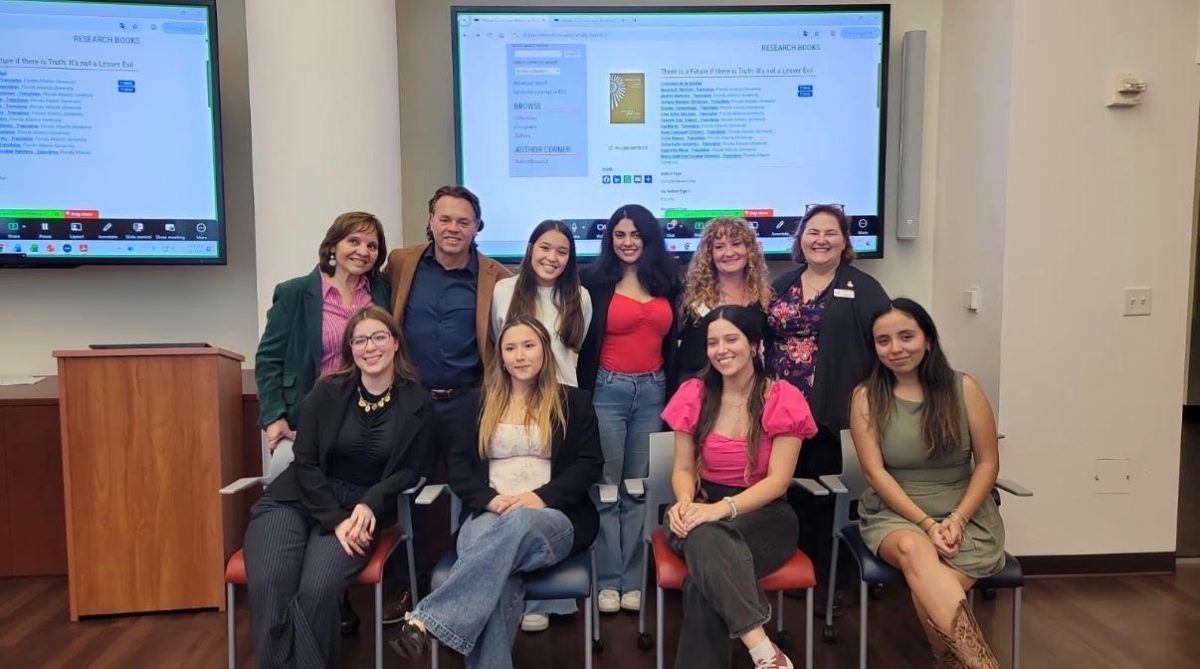
Florida Atlantic has become the first University to publish translated documents from the Colombian Civil War, thanks to the efforts of the Center for Peace, Justice and Human Rights (PJHR) and the Hispanic-serving Institution Research Interest Group.
These documents highlight the experiences of residents of Colombia during the Colombian Civil War that began in 1964, between the Colombian government, Revolutionary Armed Forces of Colombia (FARC), and the National Liberation Army (ELN).
According to the Statista Research Department, over 221,000 civilians were killed due to the conflict. However, in 2016, the Colombian government and FARC signed a peace agreement that is now 10 years old.
The group has already successfully published a translated version of “Hay Futuro si hay Verdad: No es un Mal Mayor,” or “There is Future if there is Truth: It’s not a lesser evil,” which focuses on what children and adolescents experienced during the Colombian Civil War.
“This provides the students an opportunity to learn about their history, their culture, their country without the pressure of their families, without the pressure of what society wants them to think,” says Andres Ramirez, Co-Chair of the Hispanic Survey Institution Research Group and associate professor in the College of Education.
Angela Nichols, Director of PJHR and an associate professor of political science, says the documents are important for those who are not Colombian as well.
“These documents are not only important for Colombians, but they’re important historical documents for the rest of the world, for people who study conflict and human rights, for other peace movements, for other people advocating for their own peace agreements,” said Nichols.
Cleo Miyake, an FAU High School senior, says while she’s not Colombian herself, she’s become involved with the culture through the project.
“I’ve learned such a dark part of Colombia’s history, not taught in classrooms, yet a part which should not be forgotten,” said Miyake. “I’ve learned how common it is for voices to be silenced and history to be erased, and at the same time, the role we can play in amplifying those voices and teaching that history.”
Untranslated documents came from La Comisión de la Verdad, also known as the Truth Commission, in 2022 as part of the final agreement to achieve peace. There are over 23 volumes of material and thousands of pages, according to Nichols.
The project is led by Ramirez and Nichols, who have been colleagues for over seven years, after Ramirez helped Nichols begin her fieldwork in Colombia, researching “why women participate in rebel movements,” and allowed Nichols to stay with his family in Medellin.
With a team of students recruited through flyers, emails, and word of mouth, each week each group is assigned 40 pages to review and translate, and then meets the following Monday to discuss any nuances.
Nichols says they do this because Artificial Intelligence and big language processing models can’t effectively embody the most important components of the documents the way that humans can.
During a meeting, the translation team extensively discussed the word “campesino” and its meaning in the context of the documents. In Colombia, campesino means someone who works in the countryside; however, AI sources translate the term as ‘peasant’. Nichols felt this was recolonizing language that keeps Colombia recognized as the “global south” or “the developing country.”
“We would actually spend, or devote if necessary, a whole hour to one word or certain words because we really want to maintain the voice and be really true to these people,” said Ramirez.
Nichols says that an important part of this project is to ensure non-repetition, meaning not allowing this conflict to happen again, especially because of failed peace agreements between the Colombian Government and the FARC in the past.
This sentiment is shared by Sofia Gallo Gutierrez, a team member originally from Colombia. “No repetition, I think, is like the most important thing we’re trying to discuss here,” said Gallo.
Gallo also says that joining the team was a good way to feel more connected to her Colombian history.
“It’s a really good experience to get to know the history and mark these documents, not just for us Colombians, but for all people,” says Gallo.
Both Nichols and Ramirez encourage students interested in joining the team to email them at [email protected] or [email protected].
Isaiah Sewell is a Staff Writer for the University Press. For information regarding this or other stories, email [email protected] or contact him on Instagram @izayahx_.