The Seattle Seahawks’ victory over the New England Patriots may have decided the championship, but for many viewers, Bad Bunny’s performance was equally anticipated.
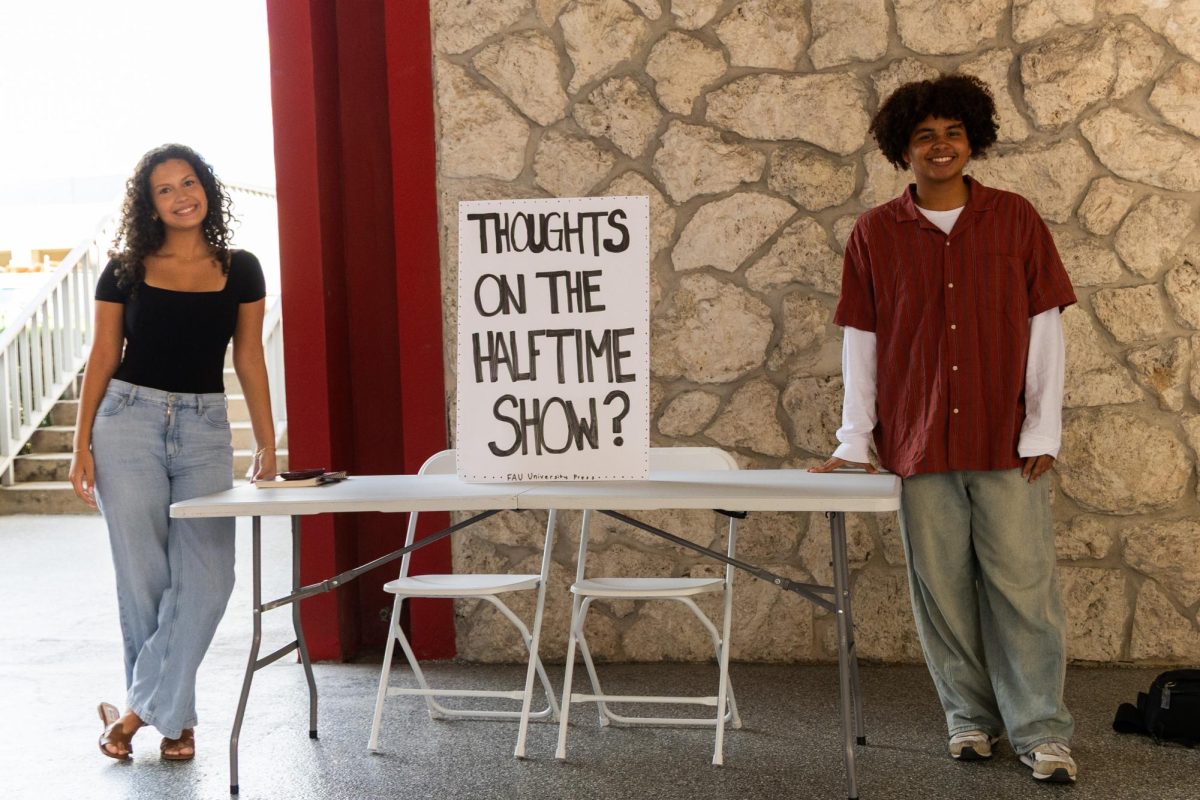
Millions of viewers tuned in Sunday night as Super Bowl LX – or as some called the “Benito Bowl” – brought football fans together for the biggest game of the year. For many, the halftime show is just as anticipated as the final score. Bad Bunny took the stage, and FAU students had plenty to say about whether the performance lived up to the hype.
Bad Bunny entered the night as one of the most influential artists in the world, fresh off making Grammy history with the first all-Spanish album to win Album of the Year. His selection as the halftime headliner marked a major moment for Latin music on one of the biggest stages in American entertainment.
Super Bowl halftime shows have a reputation for unforgettable performances and huge cultural moments. Each year, they generate conversation and debate over the performance, guest appearances, and artistic choices, long after the game ends; this year’s show was no exception. Much of the conservative opposition centered on Bad Bunny performing predominantly in Spanish, with some claiming this was “inappropriate” for America’s biggest sporting event.
Despite varying levels of familiarity, several students noted that the performance stood out for its celebration of Latin music, traditions, and communities, leaving memorable impressions even for those less familiar with his songs.
“I thought that Bad Bunny did his thing. It symbolizes many people’s cultures. I loved it,” said sophomore Joshua Lutor, expressing that the performance went beyond entertainment and highlighted the cultural significance of the show.
He performed fan favorites like “Tití Me Preguntó,” “Baile Inolvidable,” and “DeBí TiRAR MáS FOToS (DtMF),” keeping the energy consistent while giving each track its own moment in the spotlight.
The performance moved through multiple set designs, from a block party scene to a Latin market, with dancers filling the field in tightly coordinated routines that featured a mix of Latin-inspired dance moves.
“I love his music, and the camera work and all the songs he picked were really good. It was just good energy,” said Amanda Garces, a freshman, praising the song selection and overall production.
Fans have spent weeks speculating who Bad Bunny might bring out, with many expecting surprise appearances and symbolic moments throughout the performance.
“It was amazing, even though I didn’t understand anything he was saying. I thought Daddy Yankee was coming out for a split second, but no,” said sophomore Jared Martin, commenting on the surprising moments and anticipation for the show.
Lady Gaga surprised viewers with a salsa-style remix of her hit song, “Die With a Smile,” stepping onto the stage in a flowing Latina-inspired dress, surrounded by dancers performing salsa choreography.
Ricky Martin also appeared during the set, marking a major moment that connected generations of Latin music on one stage. His presence stood out as a nod to the artists who helped bring Latin pop into the mainstream.
“He bridged generations by including Ricky Martin and Lady Gaga,” said Everett Palmer, highlighting how the collaborations brought together multiple generations of Latin Music.
Other familiar faces appeared in the background throughout the performance, including Jessica Alba, Pedro Pascal, Young Miko, David Grutman, Cardi B, and Alix Earle, adding to the show’s star-studded feel.
One of the most unexpected moments: an actual wedding, with a couple sharing their vows while the performance continued all around them. The couple exchanged vows as dancers and performers continued the high-energy performance.
“I thought it was an amazing display of unity and amazingly done. I cannot believe that Lady Gaga and so many other celebrities made appearances. And there was an actual wedding,” said CJ Walden, a student government and Boca House representative.
As the show came to an end, dancers and performers carried flags from every nation in North, Central, and South America, as well as the Caribbean, filling the field with a colorful display. Bad Bunny held a football with the words “Together, We Are America” and displayed it for the cameras, a moment meant to symbolize unity across all nations.
The performance closed with a high-energy finale as Bad Bunny returned to the center of the field surrounded by dancers, fireworks, and elaborate choreography. The stadium scoreboard displayed the phrase, “The only thing more powerful than hate is love,” emphasizing celebration and culture, leaving a lasting impression as the stadium lit up during the final moments of the halftime show.
“I liked the message that Bad Bunny was trying to send about unity and that no matter what, we are all America and that love always conquers,” added Sarah Fisher, a freshman, sharing that the show’s themes resonated with her.
Reactions among FAU students varied, but many agreed that the performance was impactful, even if they were not longtime fans. Some praised the performance for its symbolism, cultural representation, and energy, while others, though less familiar with Bad Bunny’s music, still appreciated the overall production.
“I thought it was alright, I think there were better shows, but it was pretty cool,” noted Sam Minor, a freshman, offering a more neutral take on the performance.
Loved or not, the halftime show did what it always does: get people talking. FAU students shared a mix of approval, disappointment, and everything in between, underscoring that the Super Bowl halftime show remains a cultural moment that extends far beyond the football field.
Ana Sofia Barahona is a Contributing Writer for the University Press. Email her at [email protected] or DM her on Instagram @sofia_barahona_new for more information on this and other stories.