From tour guide to front desk staff, Florida Atlantic University offers a variety of convenient on-campus jobs for students. Eager for job opportunities, some student employees say they were unaware of the limitations they agreed to when they signed their name on the dotted line.
At FAU, university policies have come under scrutiny from organizations such as the Foundation for Individual Rights and Expression (FIRE), a nonprofit that defends Americans’ First Amendment rights.
In 2019, FIRE wrote a letter requesting that FAU change its media policies, which, according to FIRE, required faculty, student employees, and student athletes to get permission from Media Relations or the Athletics Department before interviewing with the press.
FIRE said in the letter that requiring all interviews with faculty and student employees to be routed through administration severely crippled the student press and curtailed academic freedom.
It took FAU 17 months to announce an updated set of media relations policies in 2021, which, according to FIRE, allowed “personnel may speak to the media in their individual capacity on matters of public concern without advance permission.” However, that wasn’t the last time FAU’s policies would come into question.
In 2022, the University Press wrote an article about the 2019 lawsuit filed by Benjamin Maggio, who was told by doctors that he would face lasting medical issues due to the overwhelming amount of mold in his dorm.
The following year, the University Press published an editor’s letter detailing the struggles they had in publishing this story and in obtaining interviews with resident assistants (RAs) about the mold. Multiple RAs refused to speak to the University Press or claimed anonymity, fearing probation or termination.
This directly contradicted the University’s policies, which stated: “Personnel in all departments and areas should feel free to respond to questions posed by the media concerning their departments or areas of expertise.”
And on March 29, 2023, FIRE wrote the university a second letter, requesting that they alter their policies once again due to language that some student employees may find confusing.
“[Employees] may not understand that their comments need not be cabined only to their formal areas of expertise, but may also share their personal experiences,” FIRE wrote. “It is our concern that while FAU’s policies as written are speech-protective, there is a disconnect such that employees are receiving a message that, despite policy, they are not permitted to speak with journalists, including student journalists.”
For this story, two RAs declined to be interviewed by the University Press due to the strict media training they experienced. Similarly, a front desk staff member said they could not answer questions due to their management.
Similar to FAU, FIRE urged the University of Utah (UoU) to change its Housing and Residential Education Media Policy, which, according to FIRE, did not allow for housing staff to identify themselves as university employees or discuss university policies and procedures with the media.
In a letter, FIRE wrote, “Because the policy chills student expression on pressing public issues, we urge UoU to revise the Policy so that it unambiguously respects student-employees’ First Amendment right to speak as citizens on matters of public concern.”
In response, the UoU officially updated its policy, removing its request that employees not state their positions; they must make it clear they are speaking as individuals, not as employees.
This school year, protests on campus concerning the 287(g) ICE agreement and professors’ First Amendment violations have raised concerns among student employees about their free speech rights.
Last semester, the University placed three FAU professors, Karen Leader, Kate Polak, and Rebel Cole, on administrative leave because of their controversial social media posts on platforms like X and Instagram, regarding conservative activist Charlie Kirk, who was assassinated at Utah Valley University during a debate on Sept. 10.
The professors have since claimed that in doing this, the University clearly violated their First Amendment rights, through lawsuits, posts on X and LinkedIn, or speaking with the University Press.
FAU senior and elementary education major Jashanti Gordon, who acquired her first job on campus as a 2025 Orientation Leader (OL) last year and now serves as the Programming Coordinator for the Program Board, says that what happened with the professors relates to her experience as an OL when it comes to advocacy.
During Gordon’s time as an OL last spring, FAU students protested President Adam Hasner’s presidential forum outside of the Student Union on the Boca Raton Campus. The protest on Feb. 7 was about students’ disapproval of Hasner because of his lack of experience in higher education. No one explicitly told Gordon not to attend the protest; however, the staff strongly suggested she didn’t.
“Whether you’re at the protest or not at the protest, if you’re reposting the protest, you’re still gonna get in the same trouble as if you were there yourself,” said Gordon.
Before joining the 2025 OL team, Gordon joined the National Council of Negro Women (NCNW), an organization with roots in public advocacy. Gordon says it’s unfair for her to have to “turn that switch off,” especially if she agrees with what the protesters are standing for.
Gordon says she knows OL’s who chose not to attend this year’s ICE protest because of the strong image they have to uphold, especially since they are the first to interact with students and parents.
“There’s a fine line, and instead of trying to navigate that line, they’re just like, don’t even go near the line,” said Gordon.
With social media, Gordon says she clearly remembers being told that someone would be watching her account.
However, she says she never felt uncomfortable posting because she never posted with the orientation name behind her. “I am not the job, I just so happen to have the job,” said Gordon.
Mike Hiestand, senior legal counsel at the Student Press Law Center, a non-profit organization that provides legal help and information to student journalists, expresses that courts have been clear, at least in the public employee setting, workers don’t give up all of their rights, but there are limitations they need to be aware of.
“The difficulty comes in trying to make the distinction between when a student is speaking as a private individual and when they are speaking in their role as a university employee,” said Hiestand.
“School officials need to be very careful; they are getting really close to violating those students’ rights, they don’t have 24-7 authority over student speech, they have authority over employee speech when it concerns that employee’s specific area,” said Hiestand.
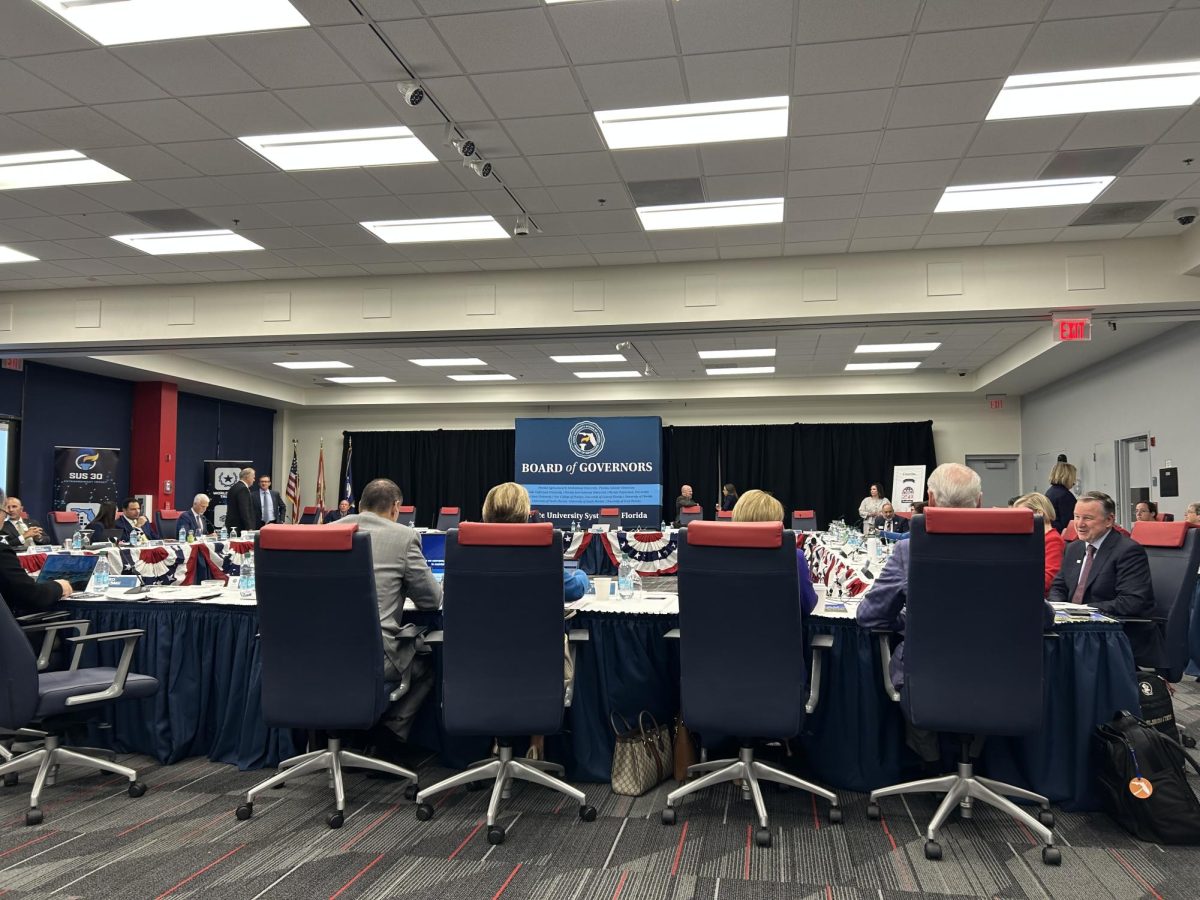
A student with experience in the Office of New Student Transitions and Family Engagement, who requested anonymity, described working during last summer’s Board of Governors meeting, where students from Florida Agricultural and Mechanical University protested the appointment of Marva Johnson as FAMU president.
“We were told [not to] make any mention of it, don’t encourage it, nothing. Just be in your position, and that’s it,” said the source. “It made me uncomfortable being like, I had to work this event still, even though I wasn’t necessarily in [agreement] about what was occurring at the event.”
On the other hand, Residential Assistant (RA) Edwards Verne, a junior at FAU, says his free speech hasn’t been limited; he sees it as simply becoming more situationally aware.
“In my role as RA, the university provides significant support, including tuition assistance, which I value greatly. I don’t feel pressured to conform out of necessity; rather, I believe the expectations are fair,” said Verne.
Regarding social media, Verne says, regardless of whether a policy is right or wrong, the three professors put on administrative leave for their social media posts serve as a reminder that online presence can have real-world implications.
“I try to be mindful of what I post, understanding that professional reputation is something you build over time but can be affected in an instant,” said Verne.
Isaiah Sewell is a Staff Writer for the University Press. For information regarding this or other stories, email [email protected] or contact him on Instagram @izayahx_.
This story is in the UP’s latest print issue, Vol. 34, “Freedom of Speech,” which can be found in the distribution bins around the Boca Raton and Jupiter campuses or in the Student Union, Room 214.