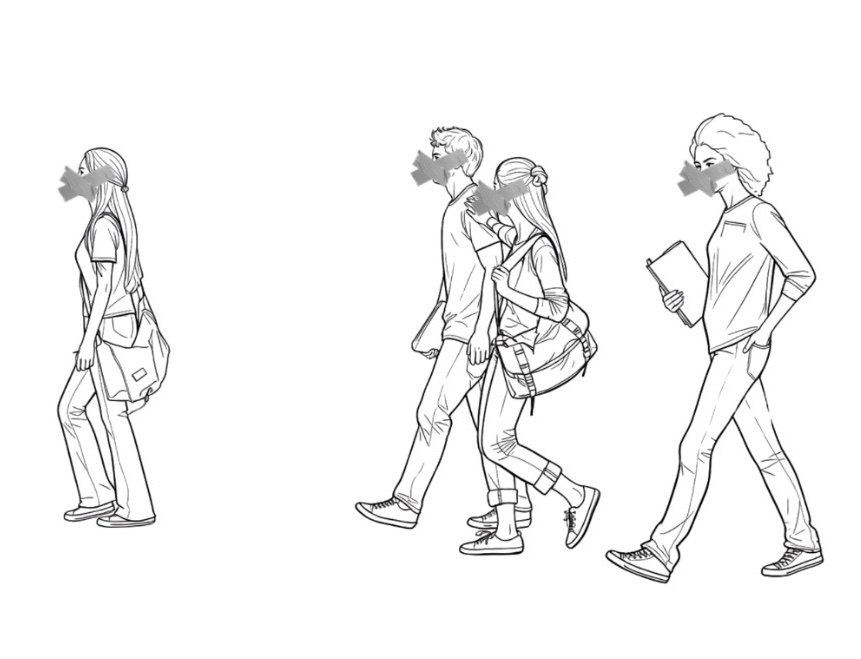
Florida Atlantic University students are self-censoring in class and on campus, according to the Foundation for Individual Rights and Expression (FIRE), which found that 44% of FAU students have self-censored at least once or twice a month. While FAU has its own struggles with self-censorship, schools such as the University of Iowa face this dilemma as well.
According to FIRE, self-censorship occurs when a student refrains from sharing certain views on campus and in classrooms, thereby damaging campus culture. Self-censorship is one of many problems with free speech; the most important one is that students are holding themselves back, and universities aren’t helping in that regard.
FIRE’s mission is to defend and sustain the individual rights of all Americans to free speech and free thought. FIRE educates Americans about the importance of these inalienable rights, promotes a culture of respect for these rights, and provides the means to preserve them.
Students speak out on self-censorship
Across all colleges surveyed by FIRE, including FAU, 28% of students have self-censored in the classroom, and 24% have self-censored with their fellow students. The University Press asked FAU students why they silence themselves on campus.
“I hide my opinions if I feel they are controversial,” said FAU freshman accounting major Keliani Ewane, explaining that she doesn’t share her opinions for fear of judgment.
An anonymous student interviewed by FIRE shared the same sentiment, stating that they don’t speak up about their political opinions when the whole group isn’t in agreement.
Another student interviewed by FIRE stated that they prefer to self-censor to maintain professionalism. “I don’t like to be controversial because I don’t think I would be making a difference by entering into a dispute with the administration,” the student said.
FAU freshman civil engineering student Sebastian Ayala-Rojas, who takes all classes in person, said students think answering something incorrectly is worse than not answering at all. “It’s funny to think about because we hear many phrases in everyday life that tell us to try even if you fail,” wrote Ayala-Rojas in a message.
Nicholas Ostheimer, the current president of the College Democrats at FAU, has spoken out on many political issues at the university, including the ICE 287(g) agreement. The ICE 287 (g) agreement allows ICE to delegate immigration enforcement authority to state or local law enforcement agencies under federal supervision.
Ostheimer wants others to come out of their shells and said people don’t need platforms; they just need to speak.
“The survival of our Republic depends on people feeling free to speak their minds, instead of falling silent due to fear,” wrote Ostheimer. He continued to say that many students across FAU have found it difficult to share their opinions.
“Just like any student at FAU, I’m not entitled to a platform, but the First Amendment gives me a right to free speech,” Ostheimer wrote in an email to the University Press.
May Rojas, a runner-up for the Boca Raton campus governor’s office and member of the Sunshine Party, wrote in a message to the University Press that even students are afraid to speak for themselves, even within Student Government, if their views are at odds with administrators at the institution.
College Republicans President Joseph Semprevivo II wrote in a message to the University Press that students don’t want to get into discussions that challenge their worldview, and also wrote that if you express opinions, others will retaliate.
“If you express opinions, people come at you calling you a racist, bigot, socialist, communist, fascist, chauvinist, feminist,” Semprevivo said. “Just because you [students] express something, doesn’t entirely mean you believe in it and doesn’t identify you.”
FAU’s responses to self-censorship
The university received an ‘F’ rating for “Self-Censorship.” According to FIRE, this is how often students hold back their views due to fear of social or professional consequences.
They restated that FAU values open expression and civil discourse, even when ideas are controversial or unpopular.
Representatives from the provost’s office and the Faculty Senate both declined to comment to the University Press for this story.
According to FAU, the provost’s office oversees all academic matters across the University. The University Faculty Senate is a governance body concerned with matters of general university educational policy, including curriculum, academic calendar and schedule, admissions, registration, and degree programs.
However, when the University Press asked FIRE how Florida Atlantic and other schools can reduce the number of students self-censoring on campus, FIRE shared that universities must stop sending mixed messages to students and faculty about which forms of expression are allowed on campus.
On Oct. 9, 2025, the University Faculty Senate of FAU and the United Faculty of Florida passed a Joint Resolution, reaffirming commitment to free expression and civil discourse. According to the resolution, public disclosure of personnel actions taken in response to public speech–when such disclosure lacks clearly articulated and specific grounds–has a chilling effect on the free expression of ideas within the university community.
“Many college administrations approach campus speech controversies as public relations management,” says FIRE Chief Research Advisor Sean Stevens. “They want it to go away, preferably quietly.”
Stevens said the arbitrary application of policy can send mixed messages to students and faculty. He said a university can improve its rating and move away from self-censorship by communicating clearly and directly.
FIRE shared that once FAU stops sending mixed messages to students and faculty, the university can take one step forward in reducing the number of students who self-censor and improve its rating in the future.
The university received an F rating for “Self-Censorship.” According to FIRE, this is how often students hold back their views due to fear of social or professional consequences.
However, FIRE gave the university a C rating on “Openness.” This category is ranked based on how many controversial topics students feel they can openly discuss on campus. FAU was ranked in the top 50 schools for student survey questions in this category.
“We believe our questions measure those constructs reliably, so we trust the conclusions from our data,” Stevens said.
Political science professor Issac Castellano has taught at Boise State University for 13 years. He believes that participation in his Civics class has decreased because students don’t feel free to express their views in the classroom.
“I think college kids just need to have a little bit more courage in their views,” Castellano said.
Brian Lai, an associate professor in the Department of Political Science at the University of Iowa, said he does not have the same problem in his classes. He believes that once an educator sets the framework for classroom discussion, students are willing to engage.
“For the classroom, work with instructors to ensure that the classroom is a space for open discussion, what that means, modeling and showing what that means, and adhering to that in discussions,” wrote Lai in an email to the University Press.
Of the 199 students surveyed by FIRE at the University of Iowa, 44% of students say they have self-censored on campus at least once or twice a month, and self-censorship was graded an F.
According to FIRE, FAU should revise its speech policies to improve its spotlight rating from yellow to green. A yellow light indicates a school receives -5 points, and a green light indicates a school earns five points.
“Free speech is an essential feature of a functioning college or university, and a democracy cannot survive without it,” Stevens said.
Anthony Ortiz is a Reporter for the University Press. Email him at [email protected] or DM on Instagram @ajortiz_38 for more information on these and other stories.