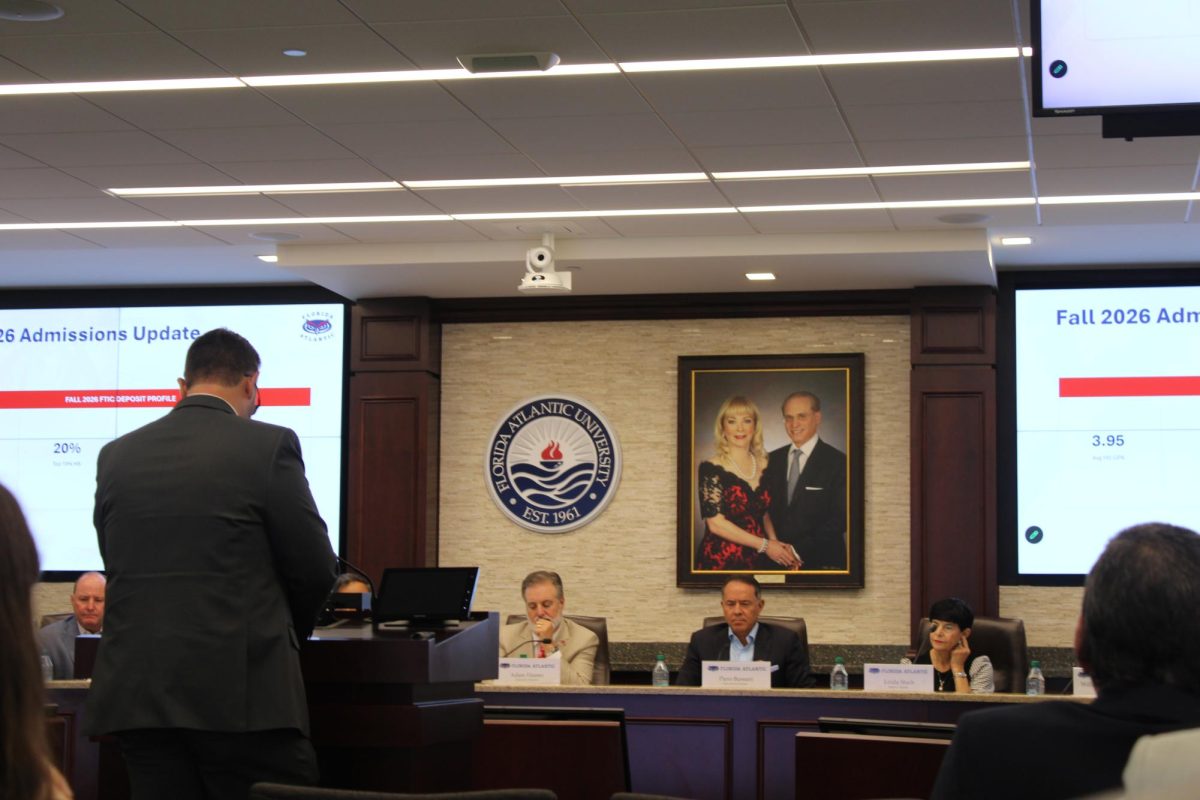
Four candidates for Student Body President and Vice President, took the stage ahead of the Student Government Spring election on Feb. 25 at the House Chambers on the Boca Raton campus.
Representing the Atlantic Party are Lance Moore, president, and Ellie Raab, vice president. Challenging them are Jack Nixon and Faisal Albaldawi of the Paradise Party.
The Atlantic Party first formed during last year’s election cycle under then Student Body President Darsham Gonzalez and Vice President Kade Salzer. Their ticket received funding from the Campus Victory Project, an initiative originally created by Turning Point USA, a conservative nonprofit that funds and trains students running for office. Gonzalez has maintained that the funding came with no political strings attached and that his administration governed without partisan influence.
This spring, two additional parties entered the race: Atlantic and Paradise. Paradise was formed by former Atlantic Party members, with party chair Jack Nixon running for president and Albaldawi for vice president, and estimated that about 90% of its members had previously been Atlantic members.
Nixon and Albaldawi are now running against the organization they once helped build, citing frustration over internal decision-making and what they describe as stalled promises.
Opening statements: Why are you running?
Moore said he and Raab are running “to better serve FAU students by merging the gap between students and university administration,” highlighting priorities such as Wi-Fi improvements, increased funding for Registered Student Organizations, parking solutions, and strengthening campus culture.
Nixon said Paradise formed after what he described as his last experience with the Atlantic Party, a failure to advocate for the general student body’s interests. He and Albaldawi are campaigning on recreation center renovations, expanded Registered Student Organization funding, transparency in Student Government, and what they call “real deliverable solutions.”
Candidate backgrounds
Moore, Boca Raton campus governor, is a junior majoring in biological sciences and has served in Student Government for two years. He previously held leadership roles within the Interfraternity Council and said he has worked to increase student engagement in athletics, marketing initiatives, and campus recreation improvements.
Raab, a junior majoring in criminal justice with a minor in political science, has been involved in Student Government for over a year. She has served on the executive board of Sigma Delta Tau and helped rebuild Students Supporting Israel on campus. Raab said her volunteer work in mental health nonprofits sparked her passion for public service.
Nixon, a New York native and a former ocean rescue supervisor, is running on initiatives including free CPR certification for students and a campus car-sharing program he says could reduce parking demand by up to 15%. “I’m running not for a title, but for results,” Nixon said.
Albaldawi, currently a House representative and chair of the Rules and Policies Committee, previously served as a student representative on the Palm Beach County School Board. There, he launched a hunger relief initiative, an experience he says aligns with Paradise’s focus on FAU’s affordability and food access.
Campus culture and priorities
When asked what kind of campus culture they hope to create, Raab asked the audience to imagine the Breezeway filled with student organizations, Greek life, and sports flags.
“That’s the type of campus community we envision,” she said, pointing to expanded tailgates, bonfires where students vote on performers, and increased student involvement as ways to build culture beyond the classroom.
Nixon said Paradise wants to build “a culture of respect,” adding that the administration should not talk down to students. He emphasized restoring The Burrow, a place for student involvement, increasing collaboration among RSOs, and “getting students out of their dorms.”Albaldawi added that the campus should feel “high energy” and unified.
What do students need most?
Albaldawi pointed to food insecurity, noting that thousands of students have indicated financial hardship on emergency applications. He proposed expanding dining hall hours to reduce reliance on delivery services and increasing student input in decision-making.
Nixon referenced a previously promised airport transit initiative that did not materialize, saying he has already begun working with Treasurer Nick Silano to advance the proposal.
Moore said he and Raab gathered feedback directly from students on the Breezeway, identifying parking, Wi-Fi, and recreation upgrades as top concerns. He proposed short-term solutions such as staggering peak class times to reduce parking congestion, noting that the highest number of citations is issued during those peak hours, and long-term collaboration with the Board of Trustees on parking lot expansion.
Nixon countered that car-sharing programs could provide immediate relief while saving students money.
One year in office: What gets prioritized?
Moore said his administration would focus on “real resolutions” and sustainable transitions so future leaders can continue projects effectively, after former members accused the Atlantic Party of failing to deliver on policies passed last fall.
Albaldawi acknowledged that not all initiatives can be completed in one year, saying Paradise would prioritize based on urgency, feasibility, and student impact.
Nixon described a tiered approach: “low-hanging fruit” like airport transit and emergency medical responders at tailgates, mid-level reforms that save students money, and long-term projects such as Greek housing development through partnerships with city officials and administration.
Audience questions and closing tone
When asked what individual quality they bring to the table, Nixon emphasized results-driven leadership. Albaldawi said integrity is central to Paradise’s campaign, noting the party’s funding comes from personal expenses and Engage, a nonpartisan organization that supports Greek life candidates without policy requirements.
Moore said relatability and collaboration guide his leadership style. Raab added that passion and listening are critical in representing a diverse campus.
The debate closed with candidates discussing how they would approach complex decisions before the Board of Trustees. Moore said his votes would be guided by what is best for students, aligned with FAU’s long-term goals, and supported by data. Nixon argued that authenticity and direct student engagement should lead decision-making.
With early voting approaching, students now face a choice between competing visions, one emphasizing continuity and infrastructure, the other promising urgency and execution. Voting for Student Government elections begins on Feb. 24 and will be open until 11:59 p.m. on Feb. 25, and is available through OwlCentral.
Emily Ives is the Political Reporter for the University Press and is reporting on the Spring 2026 election. Email her at [email protected] for more information on this and other stories.