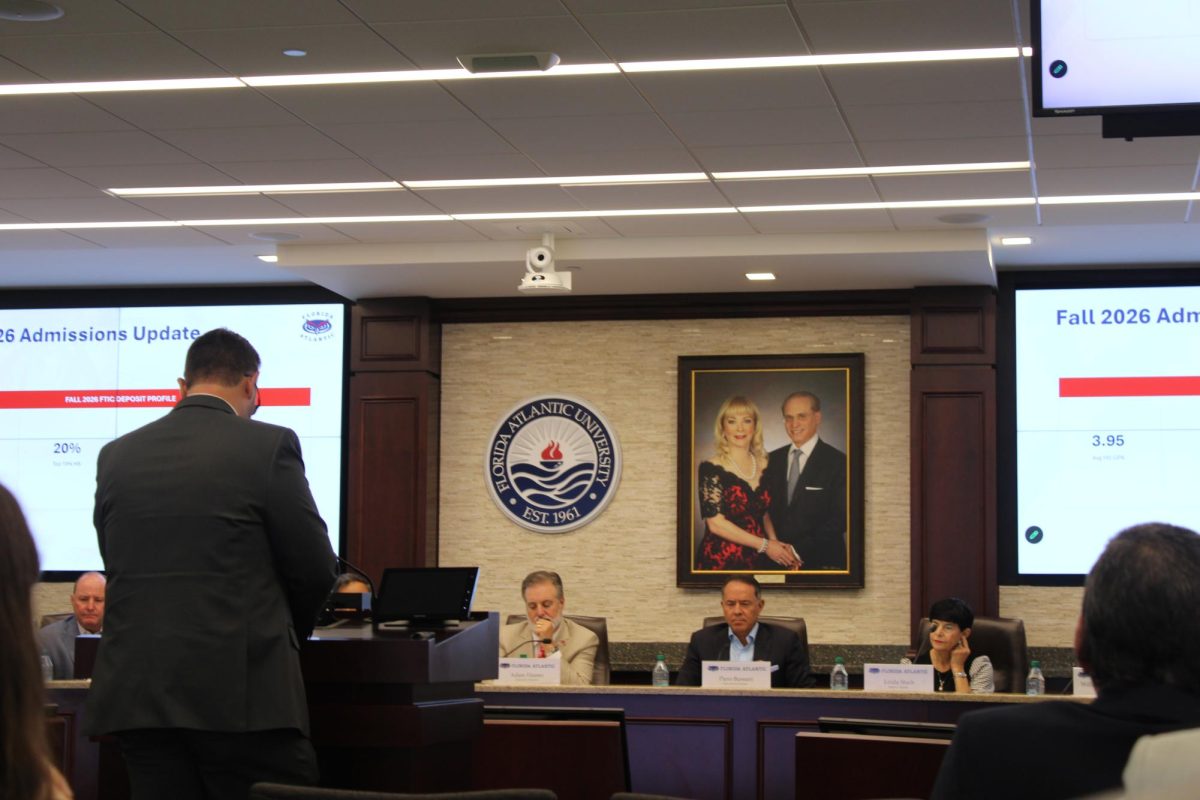
The Boca Raton House of Representatives passed a bill earlier this month, Jan. 16, that created the Boca Raton Auditing Committee (BRAC).
Representatives passed the bill, BRHB 2026-14, in a 21-4 vote at a Boca Raton House of Representatives meeting, but it was the only item on the agenda that did not pass unanimously.
Because the meeting minutes are not posted on Owl Central – where they should be according to Florida’s Sunshine Law – it’s unclear who voted against the bill. The University Press reported this past fall that student government representatives went one year without uploading hundreds of routine documents after meetings.
Nixon said the bill was created in response to concerns about transparency, long-standing spending practices, and the accumulation of unused student government funds.
“The committee looks at all of our different programs to make sure they’re adequately spending their money on responsible projects for students,” Nixon said.
Last year, Treasurer Nick Silano raised concerns about spending discrepancies within the Council of Student Organizations, which oversees registered student organizations. Silano cited administrative instability, including multiple directors stepping down, as a factor contributing to mismanagement.
The bill builds on an auditing group created by Nixon at the end of November during the Fall 2025 semester. The group is commonly referred to as the Boca Financial Accountability Committee (BFAC).
According to Nixon, the legislation gives that group formal authority rather than relying on informal oversight. “This gives the committee actual powers and rules instead of it just being a group of us who specialize in audits,” Nixon said.
The legislation comes amid broader concerns about how student government funds are allocated and retained. Nixon pointed to the University Budget Allocation Committee (UBAC), which oversees the allocations of student activity and service fees across campuses.
Nixon said that during the last fiscal year, UBAC experienced a budget cut. This year marked the first time in several years that all Boca Raton representatives were present, which, according to Nixon, resulted in a budget increase for the Boca Raton campus.
“Really, the name of the game is to spend the money while it’s current,” Nixon said. “If you put it into the revenue fund, it gets killed by inflation.”
According to Silano, the revenue fund, which functions as a restricted reserve, currently holds approximately $9 million. Unspent student government funds do not roll over from year to year and are instead absorbed into this balance.
“Even though we’ve had a technical deficit for the last five years, we haven’t spent more than we’ve budgeted,” Silano said. “Hundreds of thousands of dollars go into that fund every year, and it actually hurts our operations because we need more money to pay wages.”
Silano stated examples of groups approved with limited documentation, including a $195,000 allocation to the Boca Raton campus gym for multiple projects.
“They haven’t shown any actual evidence for why they need that money,” Silano said.
Nixon emphasized transparency around bills that allocate funds to groups; he stated that past practices made it difficult for students to understand how their fees were being spent.
“A student could see an agenda on Owl Central, but not know what a bill actually did,” Nixon said. “You could title a bill one thing, but it could really be doing something else. We’re trying to be as transparent with the student body as possible.”
Bonis, who helped sponsor the bill, said she supported it because it strengthens accountability and communication: “I feel like transparency about funds is non-negotiable,” she said.
“Holding everyone accountable for their spending is essential when it comes to the money students are paying for out of their tuition. It’s also a sign of respect. It keeps communication open and lets us know what’s going on. People work hard to come to school, and I want to make sure their money is being put to good use.”
The bill also aims to address delays caused by backlogs in the Ways and Means Committee, which reviews audits and funding requests.
“There was a backlog that delayed spending for about a month,” Nixon said. “Having a smaller committee that specializes in this helps us a lot.”
Under the bill, the committee can review budget materials, hold audit hearings, propose recommendations, and temporarily freeze spending by majority vote until the next Ways and Means meeting. It also requires the creation of an anonymous reporting form on Owl Central for students and student government officials to report potential waste, fraud, or abuse.
Silano emphasized that students and student organizations must participate in the process if they want funding decisions to change.
“If clubs want money and students want to know what’s happening, they need to come to these meetings,” Silano said. “That’s where the discussion happens.”
Silano cited recent “Ways and Means” meetings in which organizations such as Lavender Alliance, College Republicans, and College Democrats secured funding by attending and raising concerns. In contrast, he said a proposed $7,000 allocation for sports clubs stalled after no club representatives participated in the meeting.
“If you’re not going to show up for the money,” Silano said, “why should we give you the money?”
The bill now moves through the student government approval process, including review by executive leadership and Larry Faerman, vice president for student affairs. If vetoed at any stage, the legislation would return to the House for reconsideration.
Emily Ives is the Political Reporter for the University Press. Email her at [email protected] or DM her on Instagram @ivesemilyy for more information on this and other stories.