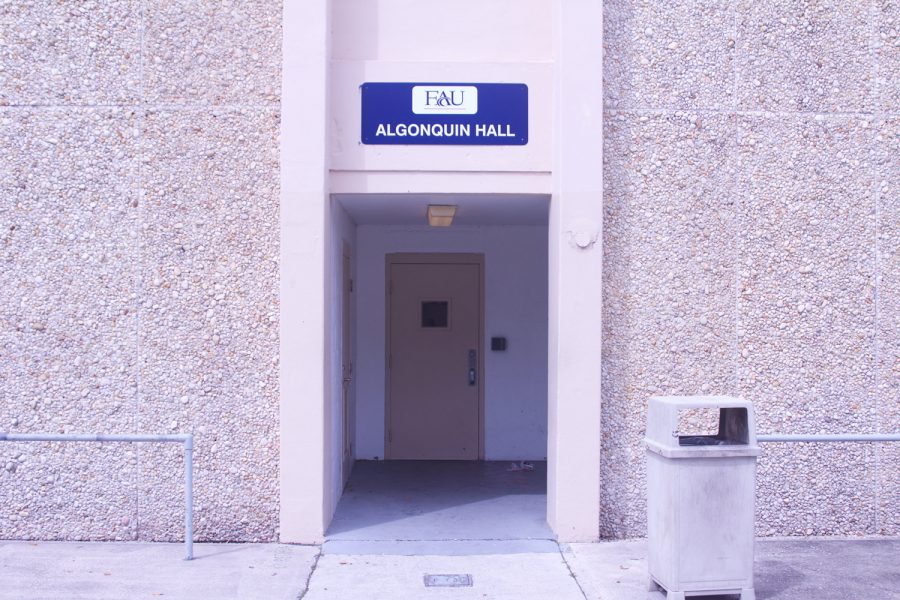
They weathered category 3 or higher hurricanes, decay and neglect by the military and later FAU. Hastily erected during four months in early 1942 from whatever second-rate lumber construction workers could scrape together from Boca Raton’s then-scrubland, they built 800 temporary barracks, storage facilities and classrooms.
They weren’t even given the courtesy of names. Just five – T-5, T-6, T-10, T-11 and T-30 (the “T” meaning “temporary”) – survive on the Boca campus now. As temporary buildings, they were crafted to warehouse top-secret equipment for the Army Air Force. The new invention? A device called radar. The buildings were supposed to linger only so long as World War II lasted.
By sheer luck, they survived.
But for the last six years, FAU administrators threatened to gut and demolish the T-Buildings. Now, three preservation groups are struggling to block the university from wrecking the last remaining historical monuments on campus.
But that still didn’t prevent three of the nine remaining T-Buildings from getting bulldozed just last year. (See T-8, T-9 and T-15 on page 9 for more information)
“The previous president, Anthony Catanese, said these buildings were worthless [in 2002] and just said, ‘let ’em all fall down,'” explains Arthur Jaffe, an 87-year-old Boca Raton Army Air Field preservation society member. “BRAAF was against that. So when Frank Brogan became president [in 2003], he took a different view. He said, ‘what can we reasonably save?'”
President Brogan’s effort called for earmarking $300,000 of the university’s budget in September 2005 to replace the roofs in T-5, T-6, T-10 and T-11, leaving T-30 – now a warehouse for FAU’s biohazard and medical waste – untouched, says Sally Ling, a BRAAF member.
Ling’s also the local author of Small Town, Big Secrets: Inside the Boca Raton Army Air Field During World War II (History Press), a history book exposing the Army air base’s classified radar experiments during the war.
“Radar was a groundbreaking device that allowed pilots for the first time to see through cloud cover at night and hone in on small targets,” says Ling. “Before – unless they had visual confirmation – they couldn’t drop their bombs. It was very crucial, because without this device the [United States] would not have won the war. Period.”
Before a freak lightning strike caught the T-3 building ablaze in May 2006, the 22,000 square-foot facility was used to store massive radar equipment during World War II. T-5 and T-6 served as radar classrooms where Army Air Force cadets tinkered, disassembled and rebuilt this technology. T-10 and T-11, meanwhile, were officers’ quarters or barracks for higher-ranking officers.
Space Utilization director Azita Dashtaki and President Brogan thought these T-Buildings seemed to mirror the spirit and design of the air field, BRAAF member Lynn Laurenti says, and this was the university’s incentive to salvage them.
That left T-8, T-9 and T-15 on the chopping block. They were also officers’ quarters which, although horribly mangled by hurricanes Wilma and Katrina, seemed nothing more than redundant buildings that violated FAU’s safety code, says BRAAF member and Boca Raton Historical Society archivist Susan Gillis.
“The buildings were structurally unsafe,” says Laurenti. “You can’t just leave an unstable building standing like that and since they [previous FAU architect Bob Freedman and President Brogan] already identified four buildings to keep up, it made sense to demolish them. Besides, they were sitting on a desirable tract of land that, when cleared, gave us a pretty open space for significant new development.”
But while South Florida weather provided the excuse, Ling, Gillis and State Historic Preservation Office administrator Bonnie Dearborn couldn’t grasp the logic. So between Feb. 22 and March 2, 2007, amid ongoing deliberations between BRHS, the BRAAF Preservation Society and FAU, bulldozers roared to life and mowed down T-8, T-9 and T-15. The official explanation? There was none, Gillis says.
“I really don’t know why they swept in so hard and fast,” says Gillis, glancing over a T-Building demolition sheet. “FAU had a proposed plan, and it called for T-8 getting the axe in June 2008 and T-9 in August 2006. Where did February 2007 come from and why weren’t we warned beforehand?”
Ultimately, “The demolition of T-8 and T-9 got bumped up because of the numerous damages it sustained … by Frances and Wilma, but there was no funding in place to repair them. Do we expand the monies that could go into that area, or take it down immediately? It was easier to demolish,” says Dashtaki, who currently chairs the T-Building Planning Committee (TBPC), formed in April 2007 by FAU.
Adds University Architect Tom Donaudy, “We had a survey done by the state and it was determined their demolition was justified. It had limited occupancy at the time and was hazardous to anyone who worked there.”
Donaudy spent $90,300 total on demolition costs from the university’s operations budget. By contrast, he said, it would’ve taken “millions of dollars” to repair them for proper use.
It wasn’t the first time BRAAF and BRHS fought to salvage the remaining nine T-Buildings. In 2004, Dearborn wrote a letter arguing T-8, T-9 and T-15 (then a derelict building) weren’t beyond repair.
In March 2005, FAU eminent scholar and BRAAF member Michael Singer pitched an amendment to the university’s Master Plan to an FAU T-Building Advisory Council. Called “Transitions,” the proposal claimed that T-8 could be ripped off its foundation and couched in between T-10 and T-11 for about $130,000. The advisory council shot it down without a second glance, citing a scarce university budget, recalls Ling, also a former chairwoman of BRAAF.
Undeterred – and still baffled – Ling, Dearborn, Gillis and Jaffe are now pushing for a long-overdue T-Building overhaul: barrel roof shingles, asphalt tiles and reinforced walls on T-5, T-6, T-10 and T-11. Spearheading that project is historical architect Susan McClellan, hired jointly by BRAAF and TBPC for $9,500.
Armed with a pad of paper, hat and camera, McClellan’s been surveying the campus periodically since her hiring last September. Her four-phase analysis will harvest data in everything from World War II-era crank windows to a rare wood called “Dade pine.”
The reason? Sometime in 2009, BRAAF and TBPC are applying for grant funding from the state’s Historical Preservation Board. Their last grant proposal, penned by Laurenti in 2005, was rejected from a field of 119 applicants.
“When you’re writing the grant proposal, it pays to be very well-honed and specific. They’re offering you money free and clear,” says McClellan. “You can’t have a grant that asks for too much stuff and it has to be a really viable project.”
After the four T-Buildings have their interiors revamped, BRAAF is pushing the university to gut T-5 -currently a derelict storage closet for architectural supplies – in favor of a warehouse for World War II artifacts and Holocaust memorabilia. Laurenti’s even recruited a donor, Martin Cohen, who’s willing to lend his collection to a future T-5 museum.
“Laurenti passed my name around the time talks began to refurbish the T-Buildings,” says Cohen. “They needed a collection. Mine was all ready to go.”
And although it hasn’t happened yet, Laurenti can already picture the memorabilia nestled in the weather-beaten T-5 building.
“I can just see a flagpole there in the grassy area and a museum inside with an interactive exhibit. Maybe a few docents at the entrance informing schoolchildren on their field trips that there used to be an Army Air Field on this very campus,” says Laurenti.
“Veterans need to be memorialized,” Cohen continues. “This museum should be there to educate future generations of young adults about the sacrifices and geopolitics that surrounded World War II.”
The Watchdog TRIO
Wanna bulldoze a T-Building? Better beware of these three preservation groups
Within six years, the Boca Raton Army Air Field preservation society has repelled the wrecking crews of two separate FAU presidents. They’ve safeguarded the last five “temporary,” or T-Buildings on the Boca campus. They’ve even gotten hundreds of World War II Army veterans and history hounds to become members.
Not bad for an organization that began as local author Sally Ling’s freelance article for the Sun-Sentinel.
“I was assigned to the BRAAF buildings, which was great because I was also working on a book (Small Town, Big Secrets) about the same thing,” says Ling, a co-founder and former chairwoman of BRAAF. “Soon, [grad student] Amy An, Arthur Jaffe, Bonnie Dearborn and Susan Gillis came aboard. As a group we had much more clout and a powerful voice.”
FAU professor Jaffe – alongside BRAAF – convinced President Brogan to form an FAU T-Building Advisory Council in June 2004. Ashamed by the careless neglect with which the T-Buildings were treated, Boca Raton Historical Society members Gillis and Dearborn pitched an idea to apply for state grant funding. The grant application was rejected in summer 2005 because, as Gillis put it, “we hadn’t gotten a proper survey done on the properties yet.”
“T-Buildings have always gotten a little disrespect – they’re not exactly glamorous anymore,” says Dearborn, also an administrator from the State Historic Preservation Office. “But then again, they’re so educational, and it’s been 65 years since World War II.”
Last April, President Brogan formed the T-Building Planning Committee, which has since hired an historical architect, Susan McClellan, to compile enough research for another grant application.
“I guess second time’s the charm,” says Sally Ling. “These aren’t just some buildings. They, and the airfield’s existence, helped us to win a war.”
FAU’s preservation group: T-Building Planning Committee
Azita Dashtaki, TBPC Chairwoman and Director of Space Utilization
Norman Kaufman, Associate Provost
Kristine McGrath, Assistant Vice President for Media Relations
Ray Nelson, Director of Facilities Planning
John Singer, Director of Physical Plant
Lynn Laurenti, Special Assistant to the Vice President
Arthur Jaffe, FAU Professor and WWII Veteran