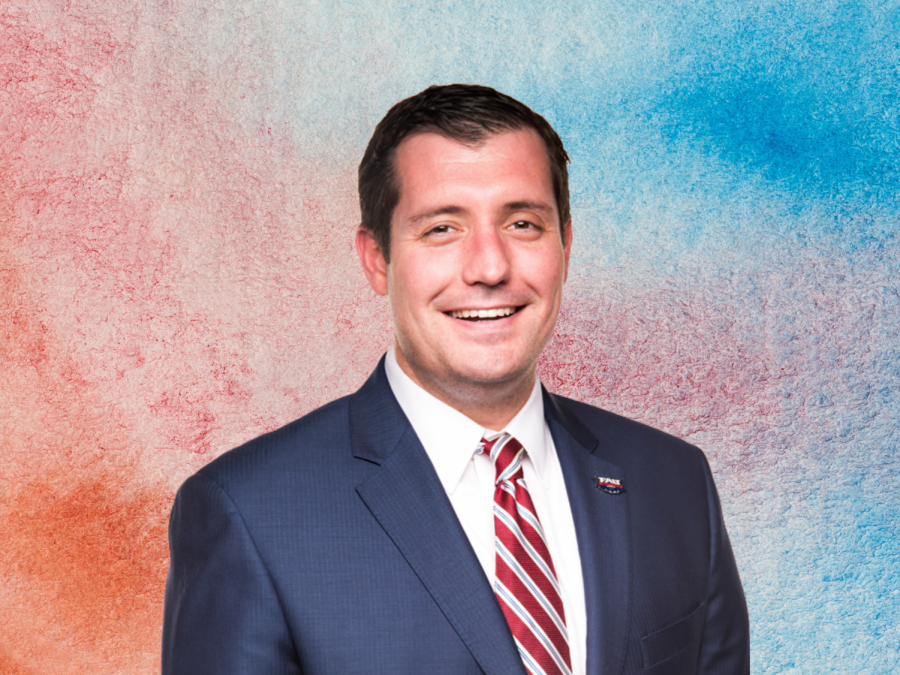
Doug Mills, a three-time Pulitzer Prize-winning senior photographer for The New York Times, spoke at Florida Atlantic University;s Boca Raton campus on Feb. 26 as part of the annual Larkin Symposium on the American Presidency, showcasing his photography of seven U.S. presidents: Ronald Reagan, George H. W. Bush, Bill Clinton, George W. Bush, Barack Obama, Donald Trump, and Joe Biden.
“You are perhaps one of the best eyewitnesses in history. And through your work, we all get to be eyewitnesses to history,” said Nicole Anslover, a history professor at FAU and moderator for the event.
The event, titled “Capturing the American Presidency,” is part of FAU’s ongoing celebration of America 250, the nationwide commemoration marking the 250th anniversary of the United States in 2026. An accompanying exhibition, “America 250: We Hold These Truths, We Walk These Grounds,” featuring Mills’ photography, will be displayed at the Schmidt Center Gallery through March 29.
Standing before a packed auditorium in the University Theatre, Mills flipped through photographs. Each image became more than a picture; as one of 13 people in the protective press pool, a group of media that travels on Air Force One with the U.S. President, Mills has been able to enter spaces most Americans have never seen.
Beyond the images projected on the screen, Mills told the stories behind each, with an underlying message about the human moments hidden within presidential power. “My job is straight down the middle. It doesn’t matter whether you’re a Republican or a Democrat. I’m just doing my job. So I have to take pictures of what’s in front of me. Pictures don’t lie.”
For more than four decades, Mills’ camera followed presidents, including Ronald Reagan, George H. W. Bush, Bill Clinton, George W. Bush, Barack Obama, Donald Trump, and Joe Biden.
Through quiet routines and national crises, documenting details that define the reality behind them.
A photo shown from when Mills first started was packs of 20 cigarettes (branded with the presidential seal and signature) that had been given to guests during the John F Kennedy administration. Mills notes the importance of this image as he tells the story behind it. The cigarettes were replaced with specially designed boxes of red, white, and blue M&Ms when Nancy Reagan switched them to Jelly Beans after smoking was said to cause cancer in 1988. Mills added, “Ronald Reagan loved jelly beans.” Mills captured a small detail that reflected broader cultural changes while also showing the personal side of the president.
Another behind-the-scenes photo showed the U.S. President Ronald Reagan on Air Force One, wearing sweatpants. Mills said, “If we had a flight longer than two hours, he’d immediately get into his room and change into sweatpants. He would always wear a shirt and tie and his coat, but he would have sweatpants down below because he didn’t want his pants wrinkled.”
Mills shared a photo of President George W. Bush in a second-grade classroom at Emma E. Booker Elementary School in Sarasota, Florida, reading a book. But that moment quickly changed when the President’s Chief of Staff, Andrew Card, leaned down to whisper in Bush’s ear that a second plane had hit the World Trade Center and that “America is under attack.”
The photo featured a raw reaction on President Bush’s face. Mills stated that when he took the photo, he had no idea what Card was saying. Mills went through photos of Bush’s entire day of 9/11, even photographed when Air Force One had its first F1 escort.
A photo of a dinner with the King of England and U.S President Trump. He notes that he had to ask for special access, which meant Trump had to ask for permission.
“I went to this dinner, and the woman said, ‘You must be really important,’ and I said, ‘So why is that?’ She goes, ‘No member of the press has been down here for over 40 years.’ The queen did not allow any media down on the state floor.”
Mills adds the importance of the trust he has built in his career. “It takes asking, and it takes trusting, but if you lose trust, they’re not going to invite you back.”
A photo of U.S President Obama actively jumping out of the car was shown. Mills told the audience, “He was like a chameleon. He could fit into anything,” noting moments when Obama was being organic in local areas, like stopping his car to play basketball with a group of people.
Another photo of Obama was shown from January 2016, when Obama became visibly emotional while announcing executive actions on gun control after a series of mass shootings, including the 2012 Sandy Hook Elementary School shooting. As he spoke about children who were killed, “this was the first time I’ve ever seen him cry,” Mills stated.
Mills then showed his recent Pulitzer Prize-winning photo of the U.S. President Trump being shot. The photo showed the bullet stretching across the air heading towards President Trump’s ear. Mills stated that he begged President Trump to photograph his wounded ear, but stated that he said no because it was seen as “a sign of weakness.”
This year’s symposium coincides with two milestones: FAU’s 65th anniversary and the nation’s ‘America 250’ commemoration, celebrating 250 years since the signing of the Declaration of Independence in 1776.
University leaders noted that bringing speakers like Mills continues FAU’s tradition of connecting higher education with national civic history, dating back to Lyndon B. Johnson’s 1964 dedication ceremony.
Mills doesn’t write just stories; he waits for them. Mill’s work inside the media differs from the headlines that follow. There are no scripts, no commentary, and no panel debates, only moments captured in real time.
Through his lens, history unfolds without narration, leaving each photograph to carry its own meaning. For students at Florida Atlantic University, the lecture offered a reminder that some of the most lasting records of the presidency are not written, they are seen.
To see more of Doug Mills’ photography, go to FAU’s Schmidt Center Gallery, where hand-selected photographs from throughout Mills’ career will be displayed until March 29 as part of the “America at 250: We Hold These Truths: We Walk These Grounds” exhibit.
Emily Ives is the Political Reporter for the University Press. Email her at [email protected] for more information on this and other stories.