Editor’s Note: This story has been edited for clarity regarding the content of Jonathan Martin’s book, “This Will Not Pass: Trump, Biden, and the Battle for America’s Future.”
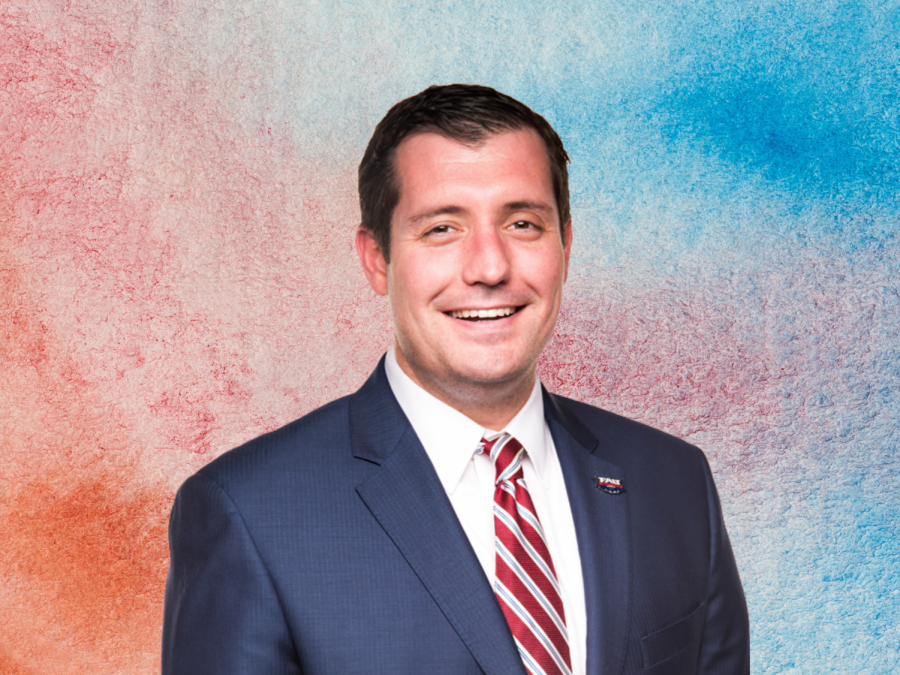
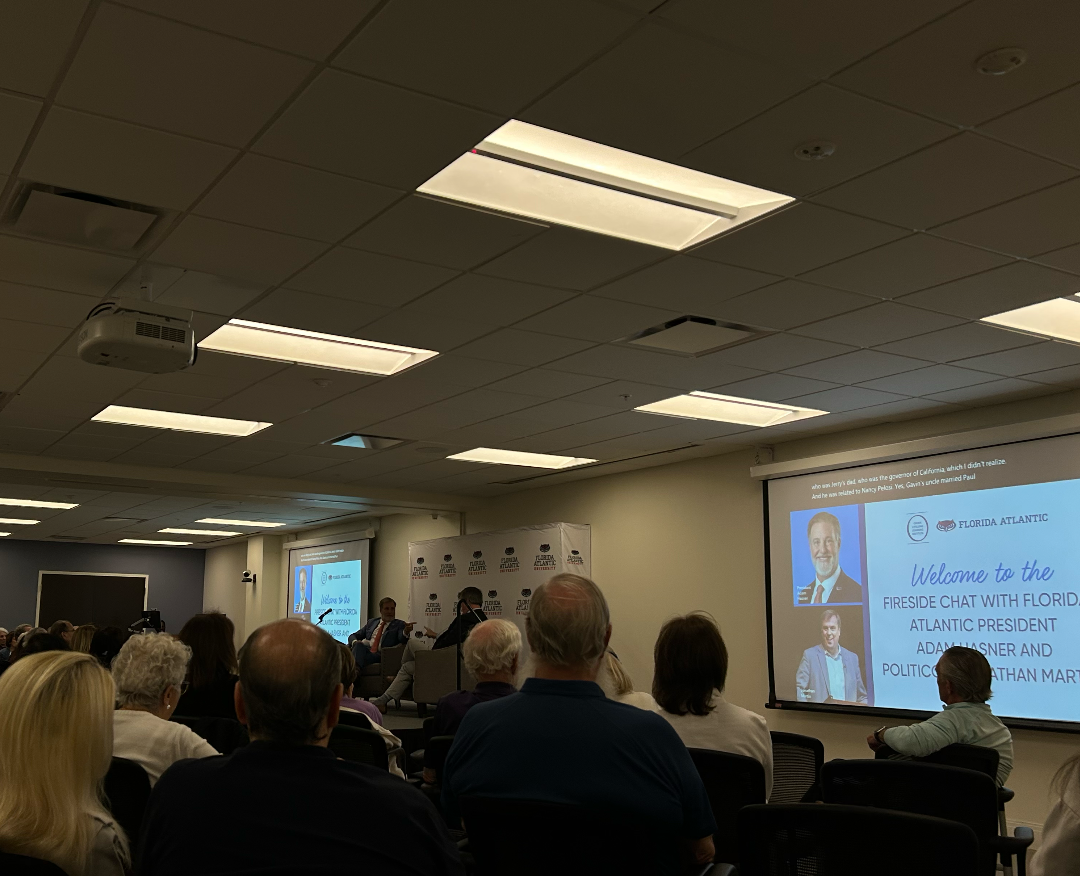
On March 17, a packed classroom in the Barry and Florence Friedberg Lifelong learning center on Florida Atlantic University’s Boca Raton campus became a forum for lifelong learning as political Journalist Jonathan Martin answered questions during a fireside chat with FAU President Adam Hasner.
The event was part of the Osher Lifelong Learning Institute and gave participants a chance to engage directly with Martin, a veteran political journalist who has worked with outlets such as Politico and, formerly, the New York Times. Martin shared insights from his travels and reporting, while audience members shared their own experiences and perspectives, highlighting how programs like OLLI foster curiosity, discussion, and continued learning among seniors and community members.
Founded in 1980, The Osher Lifelong Learning Institute at Florida Atlantic (OLLI) is a program offered at FAU Boca Raton and Jupiter campuses that offers non-credit classes, lectures, and events for “adults 50+,” as stated on its website.
The program brings in experts, including journalists, professors, and public officials, to speak on topics ranging from politics and history to current events, offering continuing education opportunities beyond traditional degree programs.
OLLI has hosted many guest speakers, including Major Garrett of CBS News, Chuck Todd, former NBC “Meet the Press” moderator, and Bob Woodward, Watergate reporter.
The event highlights FAU’s “Festival for America’s 250th,” a celebration of the United States’ 250th anniversary, featuring various events, including a Fireside Chat with President Hasner.
The celebration includes an American Revolution exhibition and special events honoring American history. Before the event, Martin and Hasner walked through the waiting area in the Barry and Florence Friedberg Lifelong Learning Center, introducing themselves, taking photos with attendees, and engaging in conversation.
At around 6:50 p.m., OLLI member Burt, who didn’t provide his last name to the University Press, was among the first to head into the event, reflecting on the importance of staying informed and engaged as an American citizen.
He noted that his grandchildren “have never watched the news,” emphasizing the importance of being informed and highlighting the opportunity FAU has given him and his generation to engage with current events.
Inside, attendees sat in a full classroom with index cards of questions, eagerly ready to take part in the Q&A session. On stage, Hasner and Martin discussed Martin’s career and the evolution of political journalism, exploring why Martin started his recent podcast, and how modern politics stand now.
Hasner noted their longstanding connection, explaining that the two first crossed paths more than 20 years ago when he served in the Florida State House, and Martin was reporting on state politics.
Martin began by reflecting on how he got his start in political journalism, tracing his path from early reporting to becoming a national political columnist.
Martin started working at Politico in 2007. One of the founders, John F. Harrison, had Martin be his researcher for his book. Harrison then invited Martin to write for Politico. Martin states that Politico at the time wasn’t widely known; he refers to it as a “garage band.”
Martin wrote as a political journalist for Politico with no writing background and just a history degree. “I really just wanted to write about, talk about, think about politics, and political history.” Martin explains that writing and reporting was self taught, “writing is osmosis…you learn to become a good writer by absorbing good writing. It’s an unconscious imitation.”
Later in his career, after Politico became more well-known, Martin was asked to work for the New York Times.
“When that call comes, you go.. It’s the opportunity of a lifetime,” Martin notes he didn’t want to leave Politico until he was offered “the big job” as National Political Correspondent. From 2013 to 2022, that is just what Martin did, covering elections around the country.
In 2022, Martin wrote “This Will Not Pass: Trump, Biden, and the Battle for America’s Future,” about the 2020 presidential election and the first year of Biden’s presidency following the January 6, 2021, attack on the U.S. Capitol.
Martin reflects that through that experience, he learned that “It was fun writing in my own voice and being able to write how and what I wanted,” which sparked the idea of creating his own column.
Given the current state of journalism companies, like the layoffs at the Washington Post, he decided to do it through Politico.
“Nobody is getting the news anymore from putting out the TV dinner at 6:30 and watching… those days are increasingly going,” Martin said, referring to the longtime NBC and ABC nightly anchors, Tom Brokaw and Peter Jennings.
“You’re grabbing this thing [phone device] and you’re getting a push alert, a text question from a relative, breaking news email, a social media ping” He adds If somehow, the Iranians tonight were blew up an oil tank or in and around the Persian, we’d all see it at the same time, because we’d be on our phones. So I’m constantly in that river of information flowing to me.”
In response to technological changes in the journalism industry and Politico’s offer, “On the road with Jonathan Martin,” a podcast featuring Martin interviewing 2028 candidates over a meal, was created.
“I’m a little different from the columnist that many of you see in the paper. I’m not an opinion columnist, I write a reported column,” Martin said.
In an interview with the University Press, Martin tells journalists who are interested in political journalism, “you need to ask yourself in your writing because you have an opinion on a situation or if you want to understand why.” Emphasizing his approach to political journalism and producing important facts. As his podcast allows him to do so.
Taken together, Martin’s experiences from building his career in political reporting to adapting to a rapidly changing media landscape pointed to a broader message: understanding politics today requires more than simply following headlines. As information becomes faster and more constant, and as politics become increasingly tied to identity, Martin emphasized the importance of slowing down, asking thoughtful questions, and seeking deeper understanding.
The event highlights President Hasner’s “Festival for America’s 250th,” a celebration of the nation’s 250th anniversary, including a Fireside Chat with President Hasner.
The message carried into the discussion itself, where audience members posed questions about the future of political parties, the role of media, and the direction of the country, reflecting the very engagement Martin encouraged throughout the event.
By the end of the session, the room of lifelong learners had gained not only insight into the inner workings of political reporting but also a renewed sense of engagement with current events.
Emily Ives is the Political Reporter for the University Press. Email her at [email protected] for more information on this and other stories.