Editor’s Note: This story is still developing and will be updated as new information becomes available.
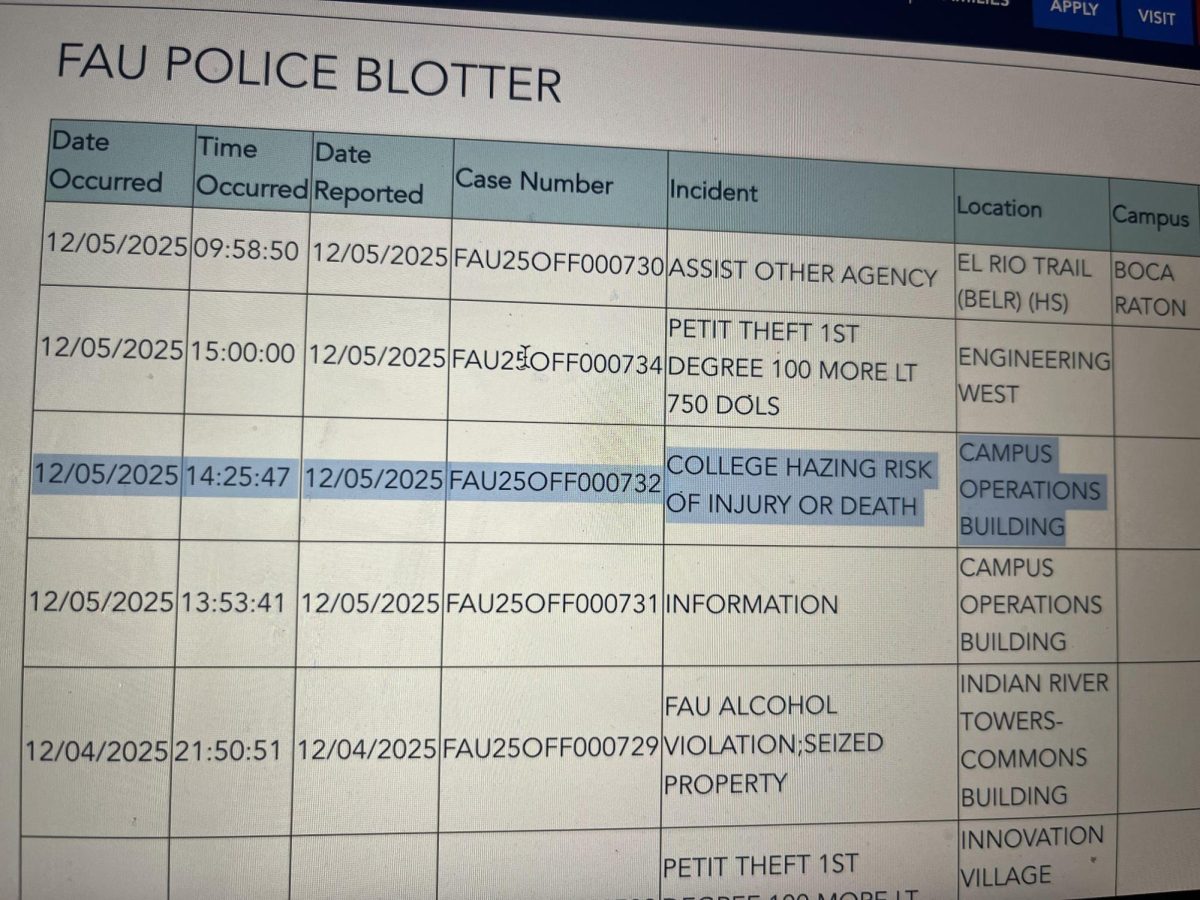
A recent hazing-related incident that “posed a risk of serious injury or death” was listed on Florida Atlantic University’s police blotter on Dec. 5, 2025, and has recently resurfaced a month after it was reported on the police blotter. The case is allegedly connected to the fraternity Delta Tau Delta and has since been changed from “College Hazing Risk or Injury of Death” to “Information” on the police blotter.
“Delta Tau Delta is aware of an injury sustained by one of its members last fall at an off-campus location. The Fraternity is working with chapter leadership and university staff to review the matter and support the injured student,” said Jack Kreman, Chief Executive Officer of Delta Tau Delta Headquarters.
Requests for records and documents that relate to the active investigation were denied by the University’s public records office, which cited the case as “exempt from disclosure”.
The University Press contacted FAU’s Interfraternity Council (IFC) for a comment, but the organization did not reply.
The University Press also contacted FAU’s Media Relations for a comment, to which they replied, “Florida Atlantic University does not comment on ongoing investigations.” They added a secondary comment saying, “The investigation is still ongoing. The university does not comment on ongoing investigations.”
According to a source who chose to remain anonymous due to the fear of backlash from students in Greek Life, the fraternity has a reputation for its intense and allegedly “brutal” pledging and hazing process that is described as humiliating and possibly dangerous initiation rituals required for new members.
There is a wide range of hazing punishments in Greek Life at colleges and universities across the nation, from being forced to consume large amounts of alcohol or other substances to acts of physical or sexual abuse. The source stated that the organization had previously encountered problems during the fall semester due to failing to initiate new members promptly.
The source stated that during their “Big-Little Night,” an event in which new members are paired with older members as mentors, a new member was hospitalized and admitted into the intensive care unit. The member reportedly underwent surgery for a wrist injury and was also treated for alcohol poisoning.
A secondary source, who also requested anonymity for the same reason, stated that the new member fell into a pool at an older member’s house and cut his arm on broken glass. The source noted that the new member incurred approximately $150,000 worth of medical bills; the University Press cannot confirm the accuracy of this amount.
In 2019, the fraternity was suspended for almost two years due to hazing allegations; however, the suspension was reduced to approximately six months, and the university neither commented nor provided an explanation. The fraternity was then put on probation for one year after the suspension.
Stuart Rosenberg, a professor of management and leadership at Monmouth University and co‑author of a 2016 research article on college fraternity risk management, said, “I feel that it’s important for the university to maintain transparency. The absence of protocols and the absence of transparency would represent two major failures that any university should avoid, in my opinion.”
Colleges are typically cautious when releasing information about hazing allegations that surface, given both student privacy laws and the potential for legal action against the university.
“Many colleges are nervous to release full details not just because of student privacy obligations, but because hazing incidents cause significant lawsuits, which can be extremely expensive,” said Pietro Sasso, a research fellow at the Piazza Center for Fraternity & Sorority Research and an Associate Professor of Higher Education at Delaware State University.
“It also draws the ire of parents and alumni because hazing is publicly received as a campus safety issue that institutions should be able to control or prevent,” said Sasso.
Molly O’Flynn is the Copy Desk Chief for the University Press. Email her at [email protected] or contact her on Instagram @molly_oflynn_ for information regarding this or other stories.